
Introduction
A car is one of the largest, most expensive products a customer will ever evaluate in person. That size and cost mean the space around the vehicle has to do real work: help shoppers notice it, understand it, compare it, and remember it.
Dealerships, automotive brands, and event marketers all struggle with the same gap. Parking a vehicle on a showroom floor or convention center stage creates visibility. Visibility alone does not create engagement, and it does not explain why that vehicle is worth a second look.
This article splits the challenge into two parts. Permanent showroom displays support everyday browsing and sales conversations. Temporary car show displays are built for attention and storytelling. We also cover layout, signage, interaction, branding, and multi-location rollout.
Key Takeaways
- Treat displays as a path through discovery, education, comparison, and action, not decoration.
- Pair vehicles with signage, demonstrations, lighting, and interactive content that supports a buying decision.
- Choose modular, durable, repeatable components for multi-location or multi-event programs.
- Track performance through inquiries, test-drive requests, QR scans, and product interactions.
What Car Showroom Displays Should Accomplish
A car showroom display isn't just the vehicle. It's the full visual merchandising system built around it.
That system typically includes:
- Platform or riser under the vehicle
- Nearby signage and lighting
- Brochures and feature screens within reach
- Fixtures for accessories or comparison products
Showroom vs. Car Show Displays
These two formats solve different problems:
- Showroom displays support ongoing browsing. Customers return, bring family members, and need time to compare models.
- Car show displays prioritize attention, recall, and social sharing in a short window—often a single event weekend.
Confusing the two leads to showroom floors that look like trade show booths (all spectacle, no substance) or event booths that read like static inventory.
Closing the Information Gap
Shoppers arrive with questions displays can answer before a salesperson ever says a word. In J.D. Power's 2025 U.S. Sales Satisfaction Index, 22% of buyers wanted a follow-up explanation of features and controls after purchase, and 53% of that group said they never got one, according to J.D. Power's 2025 Sales Satisfaction Index study.
A showroom display that explains infotainment, safety systems, or EV charging up front reduces how much of that burden falls on staff later.
A well-built display should guide a visitor through a sequence:
- Attract attention at the entry point
- Create a focal point around the featured vehicle
- Provide accessible information without requiring a conversation
- Encourage interaction with features or accessories
- Direct visitors toward a test drive, consultation, or quote

Keep the visual language tied to brand position—performance, luxury, family mobility, or sustainability. Strip clutter so the car stays the focal point and every element supports the path from first look to next step.
Car Showroom Display Ideas for Dealerships and Automotive Retailers
The showroom floor is where education and merchandising do the heaviest lifting. Here's where to focus.
Establish a Clear Focal Point
Branded vehicle platforms or low-profile display plinths separate a featured model from surrounding floor traffic. This creates consistency across showroom zones and tells customers, without a word, which vehicle deserves their attention first.
Build Feature and Technology Education Stations
Durable graphics, component samples, and hands-on displays turn abstract specs into something customers can see and touch. Chicago Show has built exactly this kind of station for Goodyear Engineered Products: an exposed timing-belt system with a stated 60,000-to-100,000-mile replacement interval. The display breaks down into:
- Gears and pulleys showing the belt's path
- A hydraulic actuator and tensioner
- The crank gear and water pump
The hardware does the explaining a spec sheet never could.
The Monroe Shocks & Struts Interactive Demo Unit works the same way. It's a hands-on counter display with a working suspension model and a 1,000-mile, 90-day risk-free trial message built directly into the fixture.
Add Comparison Displays
Arrange tires, wheels, brakes, or accessories by use case or performance category, not just brand name. Chicago Show's Dunlop Geomax MX34 counter display is a good example, listing side-by-side:
- Block-within-a-block knobs
- Progressive cornering action
- Recessed carcass design
A rebate of up to $40 prompts action on the spot.
Use Wall-Mounted and Countertop Displays
Keep brochures, QR codes, and model guides concise, and place them where customers naturally pause. Chicago Show's Ford Accessories showroom tower is double-sided, displaying truck-bed components, floor liners, mud flaps, and trim pieces, each with its own product-information card. Counter & countertop merchandisers with modular, tiered shelving handle the same job for smaller accessory lines.
Introduce Digital Screens Where They Solve a Problem
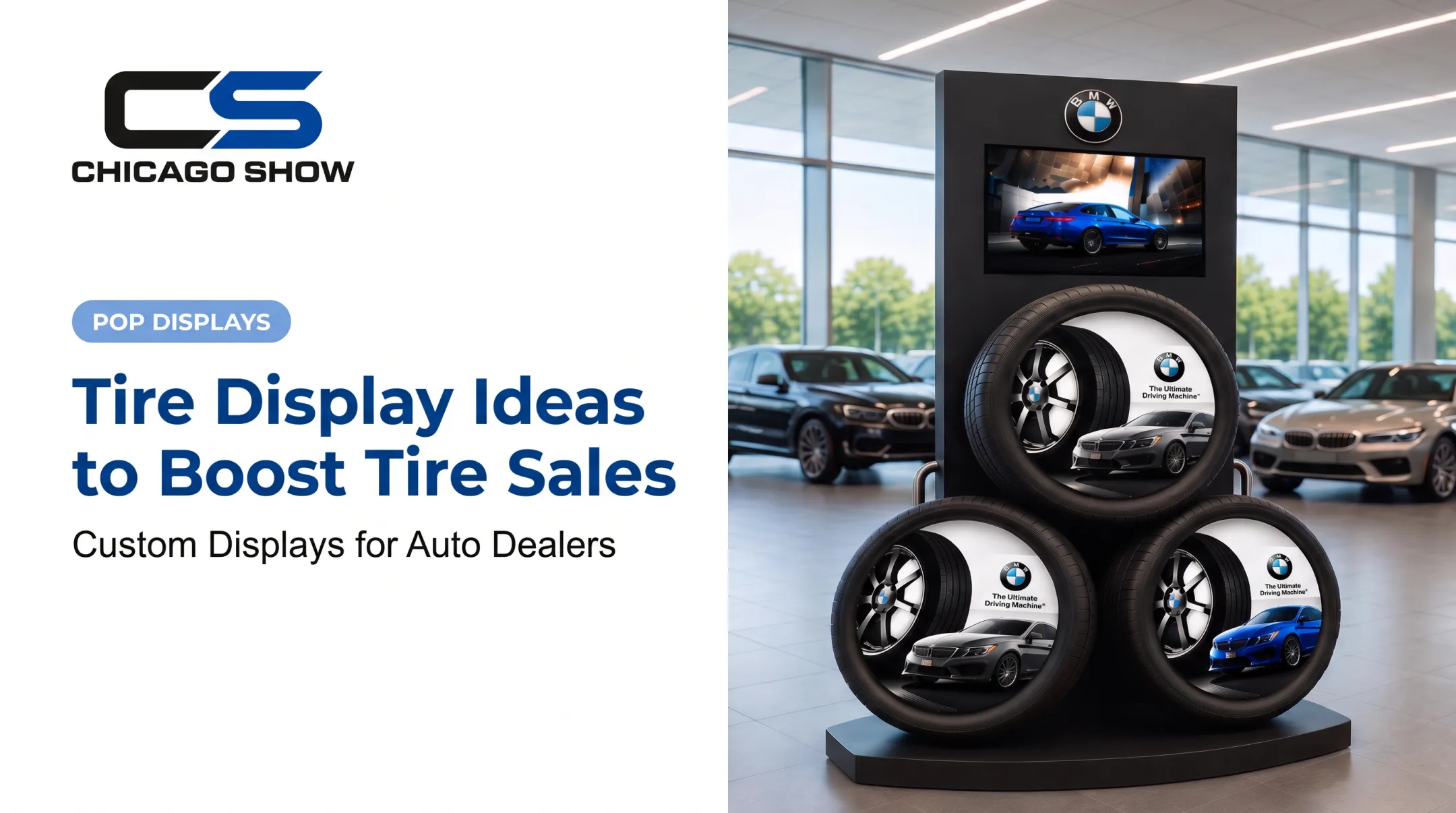
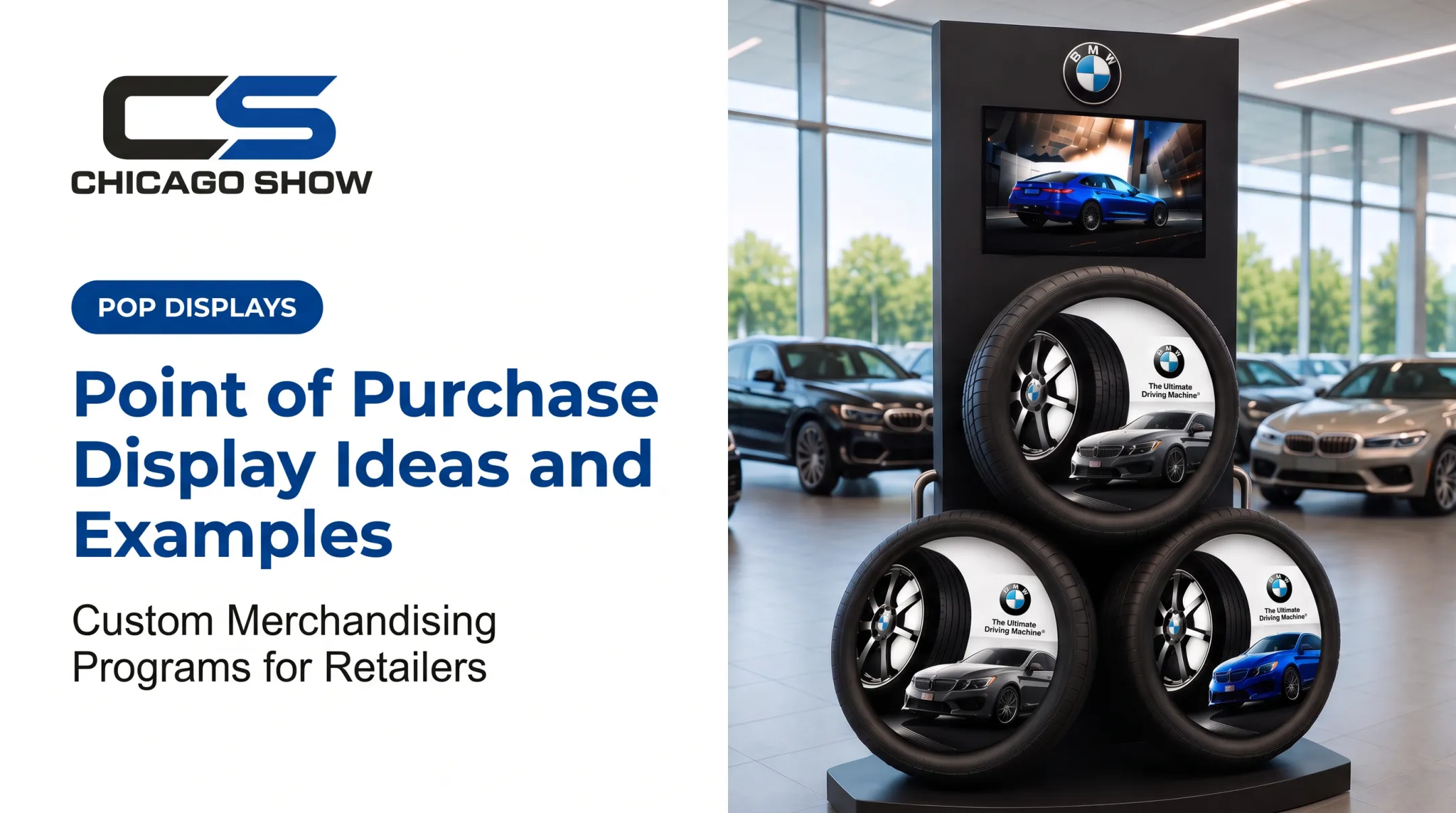
A freestanding BMW tire display combines three large tires, BMW vehicle imagery, and "The Ultimate Driving Machine" branding with a top-mounted screen. The screen demonstrates what the tires support: performance, handling, a driving identity.
Connect to Service and Parts
A Goodyear Viva 3 All-Season rolling tire display positioned outside a service center, advertising a 60,000-mile limited warranty, links the showroom purchase to after-sales support without requiring a separate conversation.
Plan for Refresh Cycles
Modular fixtures and interchangeable graphics matter for dealerships running seasonal campaigns or manufacturer promotions. Chicago Show's Tire Display Program uses modular branded panels with counter-mounted and rolling configurations, so a dealer can update messaging without replacing the whole unit. The company's broader catalog—custom floor fixtures, counter displays, wall units, and product education displays—is built to work as one cohesive program rather than disconnected pieces sourced separately.
Creative Car Show and Event Display Ideas
Events compress the entire customer journey into a few hours. The display has to do more work, faster.
Focus the Vehicle and the Space
Start with one clear hero vehicle. Focused lighting, generous negative space, and a concise headline beat a ring of competing signs.
Themed environments help when they stay out of the way:
- Outdoor recreation, urban mobility, or motorsport contexts add relevance
- Props must not block access, photography, or walking paths
- A beautiful backdrop that closes the aisle defeats its own purpose
Add Motion, Interaction, and Zones
VinFast's 2023 CES exhibit paired long curved screens with 12 projectors that mapped imagery onto the floor and the vehicle itself. Attendees could play a racing game projected onto the windshield, according to Event Marketer's coverage of CES 2023's automotive booths. Motion content can show engineering details a static vehicle cannot.
Interaction only pays off when it ends in an action:
- Configuration stations that save a build
- Virtual driving experiences tied to a follow-up
- QR product journeys that capture a lead or book a test drive
Multi-zone layouts work better than one crowded booth. Move attendees from brand introduction, to feature education, to hands-on engagement, to lead capture—the showroom journey, compressed.

Place for Traffic, Photos, and Budget
Attendees at auto shows spend real time comparing options. The Automotive Experience Alliance's 2025–2026 survey found attendees spent about 2.7 hours on site and interacted with 10 vehicles on average, according to AEA's Power of Auto Shows report.
That's a comparison-heavy environment. Displays at entrances, foyers, and session transition points catch that traffic; corner placements do not.
Design for photography at the same time: strong sightlines, uncluttered branding, and a clear backdrop encourage sharing. Watch for cables, reflections, and blocked accessibility paths.
Smaller budgets still work when the setup stays disciplined:
- Branded flags and freestanding signs
- Portable backdrops
- Modular counters and literature holders
- One well-positioned vehicle with controlled lighting
A single car, lit well, with clean signage, often outperforms a cluttered multi-element setup on a tight budget.
Planning and Executing a Car Display Program
A strong display concept still fails if planning ignores the showroom environment, traffic patterns, and rollout scale.
Start with a Written Brief
Cover the audience, display location, vehicle dimensions, model priorities, desired customer action, brand requirements, budget range, installation conditions, and timeline. Skipping this step is where most display programs go sideways.
Match Format to Environment
- Showroom floors: durable, cleanable materials for high-touch zones
- High-value product: secure fixtures that deter tampering
- Touring events: portable, packable construction
- Outdoor placements: weather-rated specs and finishes
Plan Traffic Flow Before Choosing Fixtures
Keep pathways clear, avoid blocking doors or service routes, and preserve comfortable viewing angles. Staff should be able to approach customers without creating congestion around the display itself.
Build In Modularity
Interchangeable graphics, adjustable shelving, and packable structures let a display serve future campaigns instead of becoming single-use.
Standardize Across Locations
For multi-location programs, lock a core design first, then approve limited adaptations for footprint, vehicle mix, and rollout wave. Auto and dealer network programs usually need fixtures built for showroom and service-drive conditions from day one:
- Tire displays
- Counter units
- Rolling merchandisers
- Branded floor and wall fixtures
Don't Overlook Operations
Engineering, production scheduling, kitting, pack-out, and install instructions decide whether a program works in the field—not just on the drawing.
Per POPAI's 2024 Compliance & Sustainability Report, display compliance means:
- Correct delivery
- Correct location
- Proper assembly
- Working interactive elements
Chicago Show has run dealer-network and automotive brand programs since 1902—concept through production, kitting, fulfillment, quality checks, and multi-year reorders or refreshes—so rollout waves stay consistent over time.

Measure What Actually Happened
Run a baseline and follow-up review tracking:
- Field condition after install
- Customer questions at the display
- QR scans and digital engagement
- Test-drive or consultation requests
- Hands-on product interactions
- Staff notes on what shoppers ask about
Those signals show whether the display is working—not only whether it looked right on day one.
Frequently Asked Questions
What are some creative car display ideas for a car show?
Start with a hero vehicle on a raised platform and tight, focused lighting. Add themed environments, LED or projection content, and interactive configuration stations at entry points to hold attention in a short event window.
What are some effective marketing ideas for a car showroom?
Feature education displays, model and trim comparisons, and digital configuration tools help shoppers decide faster. Pair them with branded wayfinding, accessory merchandising near service, and a clear next step such as a test-drive request.
How do you make a car showroom display stand out?
A clear focal point, disciplined lighting, generous negative space, and relevant messaging keep attention on the vehicle rather than competing signage. Strong branding and an uncluttered customer path do the rest.
What should be included in an automotive showroom display?
Include the vehicle, concise feature information, and comparison or education tools. Finish with branded signage, supporting literature or digital content, and a next-step prompt such as a test-drive request.
How can dealerships use displays to educate customers?
Hands-on component displays, trim and accessory comparisons, touchscreen feature guides, and QR-linked resources let customers explore at their own pace. Organize that content around real buying questions, not only spec sheets.