
Introduction
A permanent retail display is a long-term brand asset built to survive thousands of shopper interactions, repeated restocking, store cleaning crews, and the everyday wear of a busy retail floor.
That durability comes at a cost, which raises the real question for brand and merchandising teams: does a sturdier, higher-investment display improve product visibility, shopper education, and brand consistency enough to justify the spend?
This guide walks through what permanent displays are, when they make sense, the materials and formats available, how they compare to temporary options, and how to design, roll out, and measure a program that holds up over time.
Key Takeaways
- Permanent displays are built for years of field use, not a single promotional cycle.
- Strong candidates have established products, multiple SKUs, repeat-purchase demand, or a recurring dealer program.
- Long-term value hinges on placement, maintenance, and restocking ease, not just the upfront price tag.
- Modular shelves and swappable graphics keep a fixture relevant as products and campaigns evolve.
What Are Permanent Retail Displays?
A permanent retail display is a durable fixture built for extended use, repeated product replenishment, and consistent brand presentation in a store, dealership, or service environment. That's different from ordinary shelving, which stores whatever a retailer assigns to it, and from temporary point-of-purchase units, which are engineered for a short promotional window.
How Permanent Differs from Temporary and Shelving
A few signals typically point to "permanent" construction:
- Robust materials built to survive months or years of handling
- Stable brand messaging rather than campaign-specific graphics
- Integration into the store — floor, wall, counter, aisle, or service bay
- Repeated replenishment as a core function, not an afterthought
"Permanent" describes intended program duration and build quality, not a promise the unit stays in one store forever. Retailer resets, performance reviews, and shifting product strategy can still shorten its life in the field.
Where These Fixtures Show Up
Common formats include:
- Floor fixtures, end caps, and freestanding product racks
- Wall units, counter displays, and checkout fixtures
- Comparison boards and interactive education units
- Dealer-network and showroom fixtures
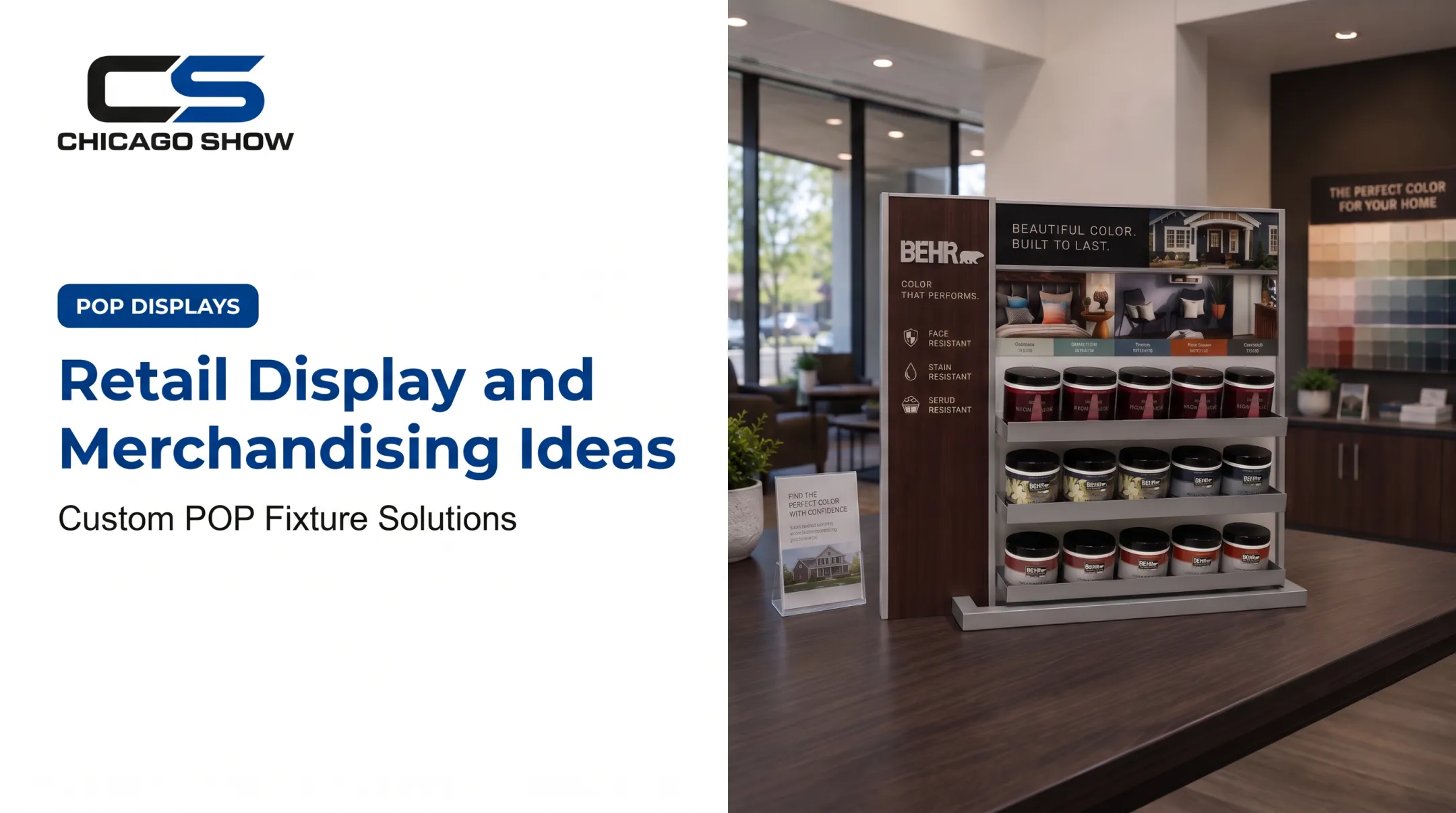
Chicago Show's portfolio shows how wide that range gets. A double-sided Ford Accessories Showcase tower, a Goodyear Engineered Products unit built around real timing-belt components, and a Behr Sample Center with tiered paint cans and color swatches all sit under the same permanent umbrella—even though they look nothing alike.
Industries that lean on these fixtures most include automotive aftermarket, dealerships, building products, tools and equipment, CPG, grocery, and specialty retail—anywhere repeat purchases and product comparison matter.
Why Invest in a Permanent Retail Display?
The case for a permanent fixture usually comes down to four things: visibility, durability, replenishment, and education.
Shoppers Notice Displays — and Remember Them
Display influence isn't just a merchandising assumption. In a January 2026 survey of 1,119 weekly in-store shoppers commissioned by Frank Mayer and Associates, 76% said they'd discovered a product or brand through a retail display, and 63% said a display influenced their choice between similar products.

That's self-reported behavior across branded displays generally, not a controlled sales study, but it's a meaningful signal that physical presentation still drives decisions at shelf.
A permanent fixture keeps that influence working every day a store is open, not just during a promotional window.
Built to Survive the Realities of a Retail Floor
Durability is the point. A permanent display needs to withstand:
- Daily handling by shoppers and staff
- The weight of fully stocked product
- Routine cleaning and floor equipment
- Cart traffic and restocking carts
- Months or years of ordinary wear
Chicago Show's Branded Fixtures & Furniture line, for example, uses steel-frame construction specifically because showroom and service-drive environments chew through lighter materials fast.
Designed Around Replenishment, Not Against It
A fixture that looks great on day one but frustrates the overnight stock crew won't stay well-merchandised for long. Good permanent design means accessible shelves, logical product grouping, and enough capacity that staff aren't restocking twice a shift.
Supporting Education on Complex Products
Technical or high-consideration products benefit most from permanent fixtures because shoppers need more than a glance to decide. Chicago Show's Automotive Service Education Displays use physical samples and clear graphics to explain tire tread wear, brake condition, and battery replacement.
The Goodyear Engineered Products display goes further, mounting real cam gears, idler pulleys, and tensioners next to a 60,000-to-100,000-mile replacement guide. That kind of detail is hard to convey with a shelf tag alone.
Brand consistency matters here too. A dealer network or multi-store rollout benefits from a shared fixture design, though local store conditions may still require adjustments to size or configuration.
Permanent Display Types, Materials, and Use Cases
Not every permanent display looks the same, and it shouldn't. Format depends on product size, placement, and how shoppers interact with it.
Formats by Placement
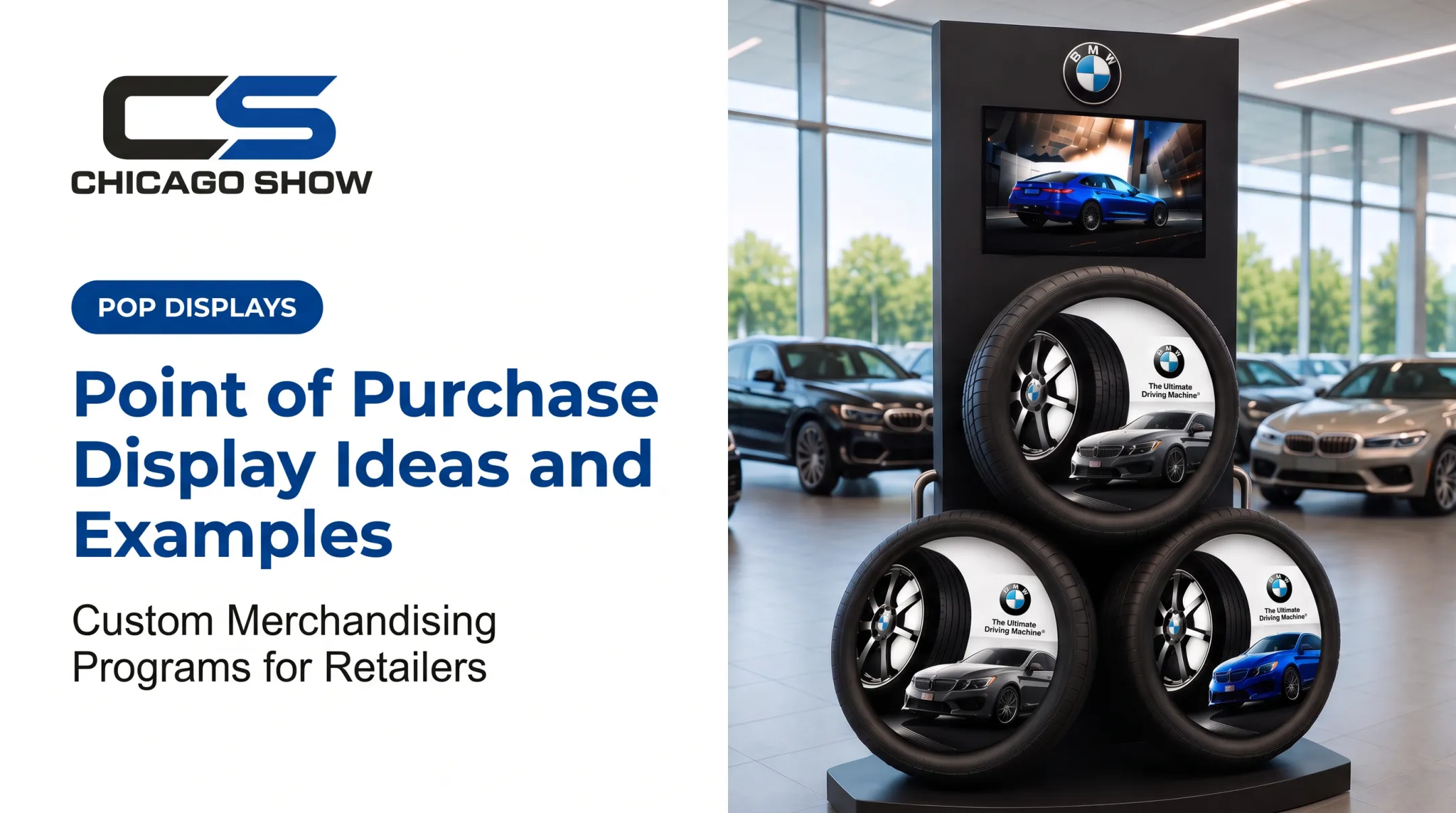
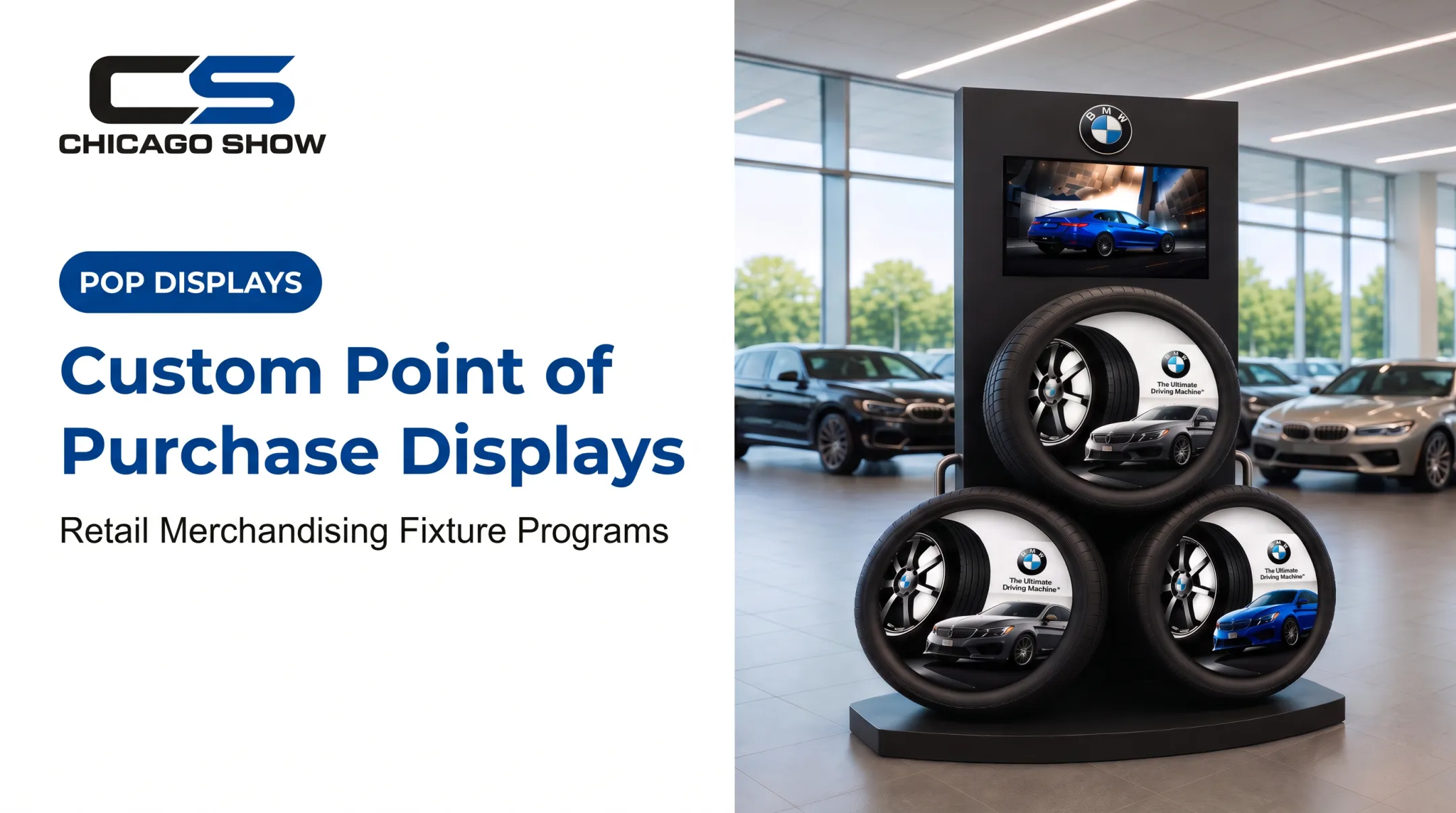
- Floor-standing units — larger assortments, like Chicago Show's Tire Display Program, which uses modular branded panels for showroom-floor merchandising
- Counter displays — smaller products or service-counter settings, often built with tiered shelving for visibility
- Wall units — category organization across tires, accessories, or retail goods
- End caps and aisle fixtures — high-traffic placement for maximum visibility
Material Trade-Offs
| Material | Strength | Cost | Best For |
|---|---|---|---|
| Metal (steel) | High | Moderate-high | Load-bearing frames, high-traffic areas |
| Wood | Moderate | Moderate | Warmer finish, showroom or retail aesthetic |
| Wire | Moderate | Low-moderate | Lightweight racking, ventilation needs |
| Acrylic | Low-moderate | Moderate | Product visibility, clean sightlines |
| Composite/printed panels | Varies | Low-moderate | Graphics-heavy branding |
Many programs blend materials rather than picking just one. The STIHL branded retail fixture Chicago Show built pairs a thick engraved wooden seat with a black steel frame — durability where it's needed, warmth where it matters for brand feel.
Modular Features That Extend a Fixture's Life
A well-built permanent display should flex as products and campaigns change:
- Adjustable shelves for new SKU sizes
- Interchangeable headers and graphic panels
- Removable trays for seasonal swaps
- Space reserved for future products
Modular flexibility matters across programs, but design emphasis still shifts by customer segment:
- Automotive and building-product displays prioritize side-by-side comparison
- Consumer brands lean toward sampling and demonstration
- Dealer and service-center programs focus on organized, branded structure
Materials choices are evolving too. Suppliers like Agility Retail have reported 2026 projects using recycled wood and recycled acrylic for retailers including Wayfair, though sustainable sourcing is not yet standard practice.
Permanent vs. Temporary and Semi-Permanent Displays
Choosing a display format starts with being honest about how long the program needs to last.
Temporary displays suit seasonal campaigns, product launches, limited-time offers, or anything likely to change quickly. They're typically lighter-built and less expensive upfront.
Semi-permanent displays sit in between. They offer more visual polish and stability than a temporary unit, without the full commitment of a permanent fixture.
Permanent displays are built for multi-year programs. They use heavier materials, support higher product capacity, and keep brand presence consistent across locations with only occasional graphic updates.
Industry award classifications give a useful reference point. Shop! Association's 2026 U.S. OMA award rules define temporary displays as intended for five months or less and permanent displays as six months or more. Those cutoffs are award-category thresholds, not engineering guarantees.
| Factor | Temporary | Semi-Permanent | Permanent |
|---|---|---|---|
| Intended lifespan | Weeks to a few months | Several months to about a year | Multiple years |
| Construction | Lighter, often corrugated | Moderate durability | Heavy-duty materials |
| Upfront investment | Lowest | Moderate | Highest |
| Update frequency | Frequent | Occasional | Rare (graphics only) |
| Product capacity | Limited | Moderate | Higher |
A hybrid approach often makes the most practical sense: a permanent fixture provides the enduring branded structure, while swappable graphics, inserts, or trays handle seasonal and product-specific updates.
Before choosing, ask:
- How long does this campaign need to run?
- Is the product mature enough to justify a bigger investment?
- What will replenishment look like in-store?
- What happens to the fixture when the program ends?
Designing and Rolling Out a Permanent Display That Works in the Field
A display that performs in a design review doesn't always perform on an actual retail floor. Getting there takes a structured process, from brief to rollout to ongoing support.
Start With a Design Brief, Not a Sketch
Before any concepting starts, lock the brief around the realities of the program:
- Product dimensions, weight, and SKU count
- How staff restock it and how shoppers use it
- Placement, store restrictions, and brand standards
- Accessibility, security, and cleaning requirements
- Expected program duration
Chicago Show's Understand the Program stage exists for exactly this reason: nail down the product, environment, and business goal before any material gets specified.
Engineering for the Real Store Floor
Showrooms are controlled environments. Retail floors are not. Good design accounts for:
- Uneven floors and stable bases, with levelers where needed
- Narrow aisles and realistic clearance for carts
- Rounded or protected edges near high-traffic paths
- Load-bearing shelves rated for actual product weight
- Clear sightlines for both shoppers and restocking staff
Graphics matter here too, but less is more. Fast comprehension, clear product differentiation, and an obvious next step beat a fixture crowded with copy every time.
From Prototype to Shelf: Production and Ongoing Support
Before full production, run the prototype through engineering review and physical testing for stability, product fit, assembly ease, durability, and cleanability.
Chicago Show follows a five-stage process: understand the program, review details, manage production, manage through delivery, and support after launch. Quality Oversight checks every unit against spec before it ships.

Rollout planning matters just as much as the build itself:
- Confirm quantities and store variations before production starts
- Plan packaging and delivery windows around retailer requirements
- Organize kitting and pack-out so each location receives a complete set: parts, graphics, instructions, and product
- Sequence rollout waves if locations open on different timelines
- Build in post-launch support for reorders, graphic refreshes, and field feedback
Chicago Show's Kitting, Pack-Out and Fulfillment service handles this complexity across multi-location programs. One point of contact covers the first call through ongoing reorders, which matters when dozens or hundreds of locations roll out on different timelines.
Measuring Permanent Display ROI and Long-Term Performance
The sticker price of a permanent display is only part of the real cost. A fair ROI picture also folds in the full program stack:
- Design and engineering
- Prototyping and graphics
- Packaging, freight, and kitting
- Installation and maintenance
- Replacement parts and periodic refreshes
- Eventual removal or recycling
What to Measure Beyond the Invoice
Relevant performance measures vary by category, but commonly include:
- Sales or unit movement at the display location
- Conversion and attachment or cross-sell rates
- Replenishment frequency and product availability
- Shopper interaction and dwell time
- Retailer compliance with planogram placement
- Display condition and labor required to maintain it
Setting a Fair Comparison
Compare performance against a relevant baseline: a control location, the previous shelf placement, or a comparable store group. Factor in pricing changes, promotions, seasonality, and retailer resets that could skew results.
Early launch numbers rarely tell the full story. The right measurement window depends on the category and program, not a fixed timeframe applied across the board.
Measurement frameworks from the display industry offer useful reference points, even when they stop short of universal benchmarks.
POPAI UK & Ireland's 2012 Grocery Display Effectiveness Study analyzed more than 7 million shopper interactions across three retail chains. It treated impact, engagement, and conversion as distinct stages brands can track. Use that structure as a model, with the caveat that the data comes from grocery settings and mixed display types.

Qualitative feedback still matters. Ask store employees, dealers, and sales reps about restocking ease, product understanding, and fixture stability. That input often surfaces problems a sales report never will.
Frequently Asked Questions
What is a merchandising display?
A merchandising display is a fixture or structure used to organize, highlight, explain, or sell products in a retail or dealer setting. Permanent displays are built for long-term, repeated use, while temporary units are designed for a short promotional window.
What are the different types of product displays?
Common formats include floor, countertop, wall, end-cap, rack, pallet, interactive, and point-of-purchase displays. The right type depends on the product, placement, how shoppers interact with it, and how long the program needs to run.
What are the 7 types of window displays?
Seven common window-display styles are open-back, closed-back, semi-closed, elevated, shadowbox, corner, and island. These describe window presentations specifically and aren't interchangeable with permanent in-store fixtures.
What is the purpose of a display?
Displays attract attention, organize products, communicate benefits, support comparison or demonstration, reinforce brand identity, and make products easier to find and buy.
What are the key retail display trends for 2026?
Reported 2026 trends include modular, reconfigurable fixtures, recycled or traceable materials, and fixture-integrated tech like digital signage and sensors. Electronic shelf tags remain in early U.S. adoption, so most programs favor adaptable displays that are easier to maintain over full redesigns every few years.