
Brands and retail teams often lose sight of that last part. A University of Texas McCombs study tracking one major retailer's rollout found that nearly a third of promotional displays sent to stores were never installed, and only 2% went up and came down on schedule. The same study linked lower installation rates to larger, more complex displays — exactly the kind of program most brands are trying to run.
Add in unclear specifications, product-weight requirements, tight rollout deadlines, and packaging that doesn't survive freight, and it's easy to see why choosing a manufacturer on unit price alone backfires.
This guide covers what custom retail display manufacturing actually involves, how the process runs from concept to fulfillment, what shapes material and design decisions, and how to evaluate a manufacturing partner for a U.S. rollout.
Key Takeaways
- Winning displays balance brand impact, easy product access, shopper education, field durability, and repeatable production.
- Plan the full path—concept, engineering, prototype, production, inspection, pack-out, and fulfillment—before you lock specs.
- Choose materials from product weight, traffic, finish goals, budget, and shipping constraints—not aesthetics alone.
- Compare partners on total program value: quality control, communication, rollout support, and reordering—not unit price alone.
What Custom Retail Display Manufacturing Includes
Custom retail display manufacturing is the design and production of physical merchandising units built around a specific brand's product, store environment, shopper journey, and rollout plan. Every dimension, material, and finish is specified for that program rather than pulled from a generic catalog.
Common Display Formats and Where They Show Up
Most custom programs use one of these formats:
- Counter and countertop merchandisers for checkout areas and showroom counters
- Floor displays and endcaps for grocery, mass, and specialty retail
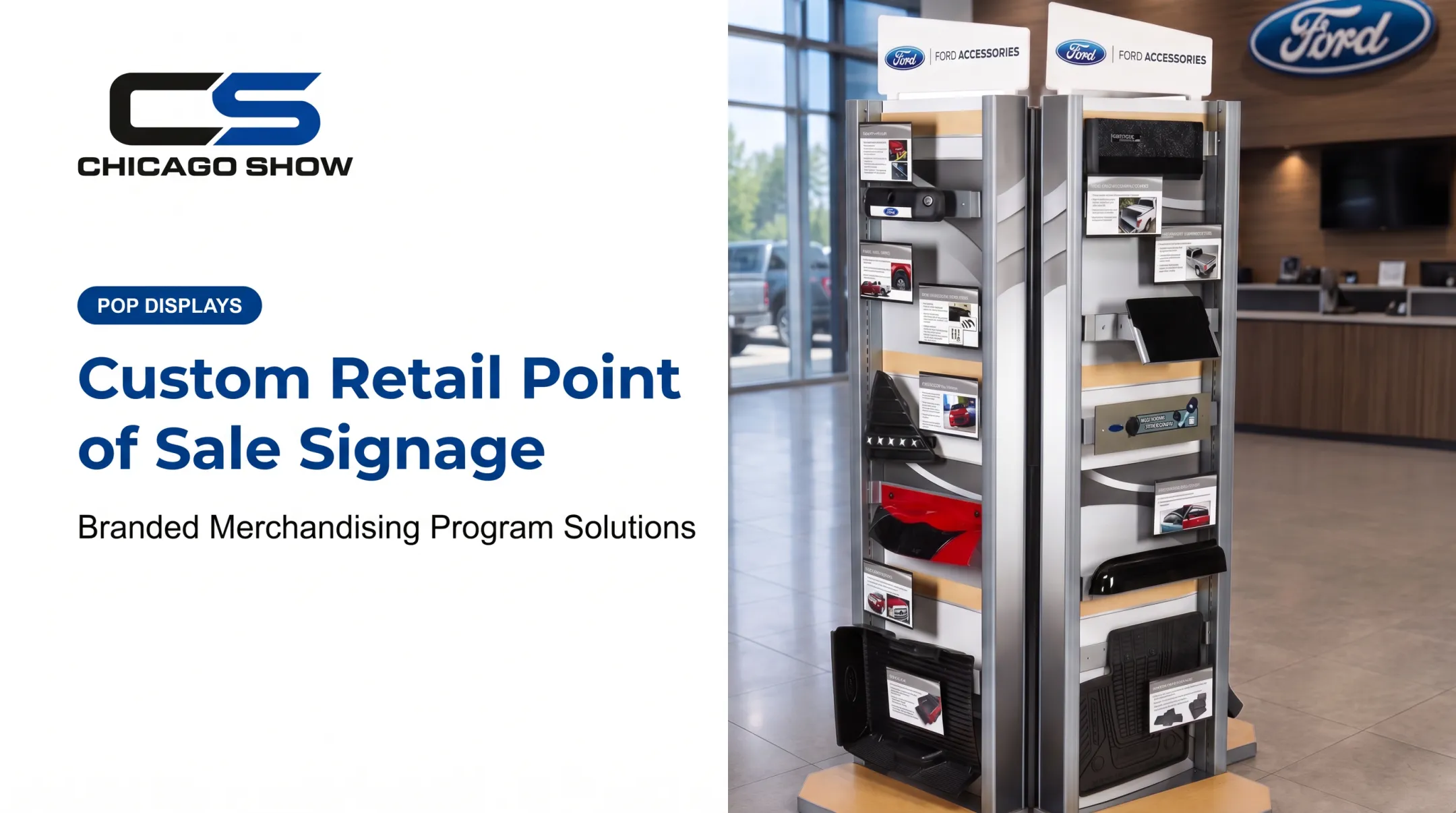
- Wall-mounted units and accessory towers for parts and tool departments
- Sample boards and comparison stations for building products and paint
- Interactive demo units that let shoppers handle or test a product
- Dealer and showroom fixtures for automotive and equipment brands
Those formats line up with how different buyers use them:
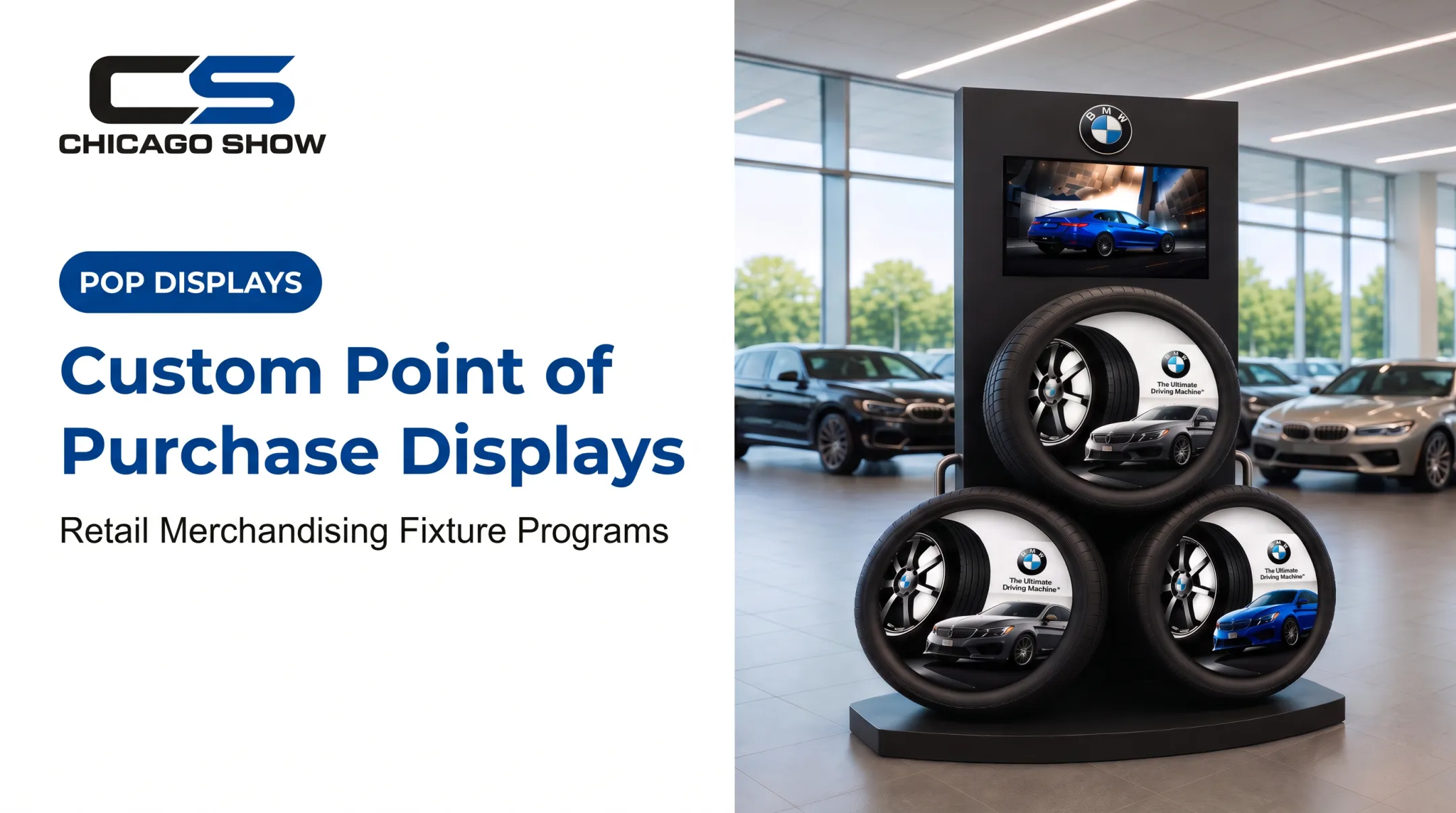
- Automotive aftermarket brands and dealer networks: tire displays and counter units in service drives
- Building-product manufacturers: sample boards so buyers can compare finishes side by side
- Marketing agencies: fabrication partners that produce concepts designed for brand clients
Chicago Show examples in these categories include a molded counter display with a cut tire section and rebate messaging, a modular tire display program for showroom floors, and an interactive demo unit with a clear-covered suspension model shoppers can test firsthand.
Custom vs. Stock Fixtures
A stock fixture ships in standard sizes with limited finish options. A custom display is built to a program's exact specifications: custom dimensions, branded finishes, product-specific holders, modular components, and specs that can repeat across hundreds of locations.
A physical retail display can include printed graphics, lighting, or a mounted video screen. Building that fixture is still different from manufacturing an LCD or LED panel. Panel fabrication happens in semiconductor-grade facilities. Custom retail display manufacturing covers the structure, graphics, and hardware the product sits in or on.
When brands search "display fabs," results usually point to electronics manufacturing, not point-of-purchase fixtures.
How the Custom Retail Display Manufacturing Process Works
Every program should start with a written discovery brief that defines scope before any sketch or sample image.
Discovery and Concept Development
A solid brief covers the product itself (dimensions, weight, packaging), the retail setting, how shoppers interact with the unit, branding requirements, budget, launch date, and how long the program needs to run.
Chicago Show's process begins the same way: understanding the product, environment, and business goal before anything gets drawn.
From there, sketches and renderings turn into a workable concept. This is also when a manufacturer should flag practical issues early:
- Footprint and sightlines in the actual retail space
- How the product gets replenished once the display is live
- Assembly steps, and who performs them
- Stability and how the unit gets transported without damage
Engineering, Prototyping, and First-Article Review
Concept drawings become engineering drawings: material specifications, hardware selection, load calculations, and packaging requirements.
Frank Mayer, a retail display manufacturer, describes the prototype as a full-scale model built from design and engineering plans. Teams use it to verify dimensions, manufacturability, and assembly before scaled production begins.
That first-article review should test:
- Appearance against approved renderings
- Assembly steps a store employee will actually follow
- Product fit: whether it sits, hangs, or stacks correctly
- Durability under expected handling
- Retailer-specific requirements, such as weight limits or footprint restrictions
Production Planning and Quality Oversight
Once the prototype is approved, production moves into material purchasing, component fabrication, printing or finishing, and assembly. Inspection against the approved specification should happen throughout the run, not just at the end, with any approved changes documented so the next reorder matches.

Chicago Show's production management covers the build from first article through the final run, with units checked against specification before they ship, not after a store manager calls to complain.
One Partner, One Communication Channel
The handoffs between concept, engineering, fabrication, and fulfillment are where programs usually break down.
An end-to-end partner closes those gaps by handling concept support, production management, kitting, pack-out, fulfillment, and recurring program support in-house through a single point of contact.
Chicago Show structures its work this way, carrying a program from the first call through delivery and into reorders and refreshes.
Materials, Design, and Performance Considerations
Choosing a Material Category
No single material works for every program. The right choice depends on product weight, expected lifespan, appearance goals, and budget.
| Material | Best suited for | Trade-off |
|---|---|---|
| Metal | Permanent fixtures, heavier products, long-term durability | Higher cost, longer lead time |
| Wood / engineered panel (MDF) | Structure with finish flexibility, veneer options | MDF isn't as strong as solid wood |
| Acrylic / plastics | Light-duty components, transparent panels | Limited load capacity |
| Corrugated | Temporary or seasonal promotions | Shorter usable life |
| Mixed-material | Balancing appearance, durability, and cost | Needs more engineering work |
No material is universally "best." Verify load ratings and finish durability against the manufacturer's own documentation rather than marketing copy.
Designing Around Product and Shopper Behavior
Material choice only matters in context. Design decisions should also account for:
- Product weight and how often it gets replenished
- Theft considerations for small, high-value items
- Hands-on demonstrations or sample handling
- Cleanability for high-touch environments
- Visibility from the angle shoppers actually approach from
An automotive parts display built for a service drive needs a different base and mounting than a paint sample board meant for a showroom counter.
Chicago Show's Behr paint sample center, for example, uses tiered shelves, paint cans, and color swatches arranged for a shopper standing at counter height. That is a different problem than a rolling tire merchandiser built for a sidewalk.
Branding, Visibility, and Field Durability
Color consistency, logo placement, and messaging hierarchy all need testing, ideally at the distance a shopper actually stands and under the lighting the store actually uses. A display that looks sharp in a design review can read as cluttered under fluorescent lighting six feet away.
Durability matters as much as looks. Displays get handled, loaded onto trucks, assembled and disassembled, and cleaned repeatedly. ISTA's shipping-test procedures evaluate how packaged units hold up across parcel, less-than-truckload, and full-truckload routes. That is a useful benchmark for packaging, though it tests transit exposure rather than in-store fixture life.
Designing for Manufacturing and Fulfillment
Part count, fastener choice, and flat-pack potential all affect cost and rollout reliability. Before finalizing a design, review:
- How the unit ships (flat-pack versus fully assembled)
- Pack-out dimensions and protective packaging
- Installation instructions for store-level staff
- How replacement components get ordered later
A design that looks identical on paper but ships flat instead of assembled can cut freight costs significantly across a multi-location rollout.
How to Evaluate and Select a Custom Retail Display Manufacturer
Capability, Experience, and Communication
Start by checking whether a manufacturer has actually built comparable displays with similar materials, product weights, environments, and quantities. Ask for work samples, references, and prototype examples from retail, CPG, automotive, or dealer programs.
Then look at how the manufacturer runs a project. Who owns drawing review, approvals, change control, and issue escalation? Programs that pass between a brand, an agency, a fabricator, and a separate fulfillment provider create gaps where things fall through. A single accountable point of contact closes most of those gaps.
Compare Total Program Cost, Not Just Unit Price
A low per-unit quote can hide costs that show up later. CIPS, the procurement industry body, frames total cost of ownership as acquisition, usage, and end-of-life costs combined. It also flags that a lower unit price tied to a higher minimum order quantity can raise inventory and obsolescence risk. The same logic applies to display programs.

Before comparing quotes, request an itemized breakdown covering:
- Tooling and prototyping
- Materials and finishing
- Packaging and freight
- Warehousing and kitting
- Installation and replacement risk
- Expedited shipping and reorder pricing
Review Quality Assurance and Acceptance
A manufacturer should describe its acceptance process in plain terms. Confirm it covers:
- First-article or prototype approval
- Inspection against drawings
- Finish and graphics review
- Product-fit testing
- A documented process for correcting units that don't pass
ISO 9001 certification signals a structured quality management system, but it does not by itself confirm a specific fixture passed load or transit testing. Ask about display-specific checks separately.
Assess Long-Term Program Support
A display program rarely ends at the first shipment. Ask how the manufacturer handles reorders, seasonal refreshes, replacement parts, and rollout waves across stores of different sizes.
Chicago Show builds programs around that continuity. With more than 124 years of merchandising experience, it manages custom display work from understanding the program through support after launch.
Recurring program support keeps reorders, refreshes, and rollout waves consistent with the original specification. Kitting, pack-out, and quality checks are built into each wave.
From Production to Rollout and Ongoing Support
Planning the Rollout
Once production is approved, rollout planning locks in the details that keep multi-location programs on track:
- Final quantity confirmation and location lists
- Ship-to details and packaging labels
- Assembly instructions and installation responsibilities
Multi-location programs often need different display sizes or pack-out configurations by location while keeping the core specification consistent. A 500-store rollout rarely ships as one uniform batch.
Kitting, Pack-Out, and Fulfillment
Grouping complete display units, graphics, hardware, and instructions by location or rollout wave reduces field errors. Chicago Show's kitting, pack-out, and fulfillment work includes assembly, protective packaging, inventory storage, and shipment to individual locations. That in-house management keeps a 50-location wave from arriving as 50 separate problems.
Before signing off on a logistics plan, confirm:
- Who handles warehousing between production and shipment
- How order accuracy gets verified per location
- Who manages freight and resolves damage claims
Post-Launch Review
Once displays are live, collect feedback on assembly difficulty, shopper interaction, replenishment speed, damage, and store compliance. The installation study mentioned earlier found that larger, more complex displays got installed less often. That is a strong argument for checking actual field setup rather than assuming a shipment equals a placement.
That feedback should feed directly into the next wave: design revisions, replacement parts, seasonal refreshes, and future reorders.

Frequently Asked Questions
What are display fabs?
"Fabs" usually refers to specialized factories that manufacture electronic display panels or semiconductor components under tightly controlled conditions. That's a different industry from companies that fabricate physical retail displays and merchandising fixtures.
What is custom retail display manufacturing?
It's the process of designing and producing branded physical displays tailored to a specific product, retail environment, shopper interaction, and rollout plan, not a stock fixture pulled from a catalog.
How long does it take to manufacture a custom retail display?
Timing depends on design complexity, prototyping, material availability, quantity, approvals, finishing, and fulfillment. Request a project-specific schedule that includes approval and delivery milestones.
Which materials are commonly used for custom retail displays?
Metal, wood or engineered panels, acrylic and other plastics, corrugated materials, and combinations of these show up most often. The right choice depends on durability needs, appearance, product weight, environment, quantity, and budget.
How do I choose the right custom retail display manufacturer?
Compare relevant experience, design and engineering support, prototype approval, quality controls, communication, fulfillment capabilities, total program cost, and reorder or refresh support. Do not judge the partner on the initial quote alone.