
Showroom display ideas for 2026 are shifting toward customer education, hands-on engagement, and measurable sales support. Retail association commentary points to experiential formats tied to a brand's mission, from home-improvement workshops to beauty instruction, as the new baseline for physical retail, according to NetChoice's 2026 retail outlook.
This article covers five trends driving that shift, the business forces behind them, and what to weigh before investing in a new display program.
Key Takeaways
- Showrooms are moving from decorative to interactive, educational, and experience-driven.
- Modular, durable fixtures let brands adapt displays across products, locations, and rollout schedules.
- Digital tools should solve a specific shopping task, not just add screens for their own sake.
- Accessibility, sustainability, and maintenance belong in planning — not as afterthoughts.
Showroom Display Trends to Watch in 2026
Trend 1: Interactive Product Demonstrations and Hands-On Experiences
Shoppers want to touch, test, and compare before they commit, especially for high-consideration purchases like tires, tools, or appliances.
A six-dataset academic analysis across four product categories found that in-store sampling produced both immediate and sustained sales effects, not just a one-time bump, according to research from Singapore Management University. That evidence comes from food and consumer-goods sampling, so it shouldn't be treated as a guaranteed conversion rate for automotive or tool categories. Still, the underlying principle holds across industries.
Common formats include:
- Touch-and-try stations for materials, fabrics, or finishes
- Working demonstrations that show a product in motion
- Side-by-side comparisons between tiers or competitor options
- Configurators for custom orders (color, size, trim level)
Chicago Show's Interactive Demo Unit for Monroe, for example, places a suspension model under a clear protective cover so shoppers can see and feel the difference shocks and struts make in ride control.
A Goodyear Engineered Products display takes a similar approach, mounting a real timing belt, gears, pulleys, and water pump so service advisors can point to the actual parts instead of describing them. These formats reduce uncertainty by letting people see exactly what they're buying.
Trend 2: Modular, Flexible, and Refreshable Display Systems
Fixed displays built for one product launch become expensive clutter the moment the assortment changes. Brands managing dealer networks, seasonal campaigns, or multi-location rollouts need systems that flex instead.
That means:
- Adjustable shelving and interchangeable graphics
- Movable islands that can be reconfigured for new product bays
- Modular panels that update without rebuilding the entire fixture
A 2024 POPAI UK case study retrofitted an existing cosmetics display frame rather than replacing it, reusing roughly 90% of the original fixture and cutting metal parts by 75%, according to POPAI's sustainability guide. That's one project's figures, not an industry-wide benchmark, but it illustrates the real savings possible when a fixture skeleton is designed for reuse.

Chicago Show's Tire Display Programs follow this logic: modular branded panels work across counter-mounted and rolling formats, engineered to hold up through repeated use rather than getting replaced each season.
Trend 3: Immersive Brand Storytelling Through Sensory and Lifestyle Displays
A product sitting alone on a shelf tells half a story. Vignettes, finished-room settings, and material combinations show how that product fits into a customer's actual life or work.
Research on multisensory store atmospherics suggests that letting shoppers touch or interact with merchandise can increase both purchase propensity and willingness to pay, per Charles Spence's 2014 Psychology & Marketing study. The exact lift varies by category and store.
Good storytelling displays share a few traits:
- One clear focal point, not five competing messages
- Deliberate negative space instead of visual clutter
- Materials and lighting that match the product's actual use environment
Behr's Sample Center illustrates this well: tiered shelves of paint cans and color swatches paired with home-interior imagery let shoppers picture a finished room, not just a chip of color. The goal is one clear story, not a pile of extra props.
Trend 4: Digital, Connected, and Hybrid Showroom Experiences
Digital tools extend what a physical fixture can do — QR codes for spec sheets, touchscreens for configurators, video explainers for installation steps. But adoption data suggests shoppers are selective about which tech actually helps them.
In a 2025 US survey of over 1,000 shoppers, 22% had scanned a QR code in-store, while only 8% named interactive displays as a tool that had become more helpful, according to SPAR's 2025 Shopper Insights Survey. The takeaway: match the technology to a specific task rather than adding a screen because it looks modern.

Before deploying digital elements, confirm:
- The screen or scan solves one concrete need (spec lookup, comparison, lead capture)
- Content can be updated remotely without rebuilding the fixture
- Staff know how to troubleshoot basic issues on-site
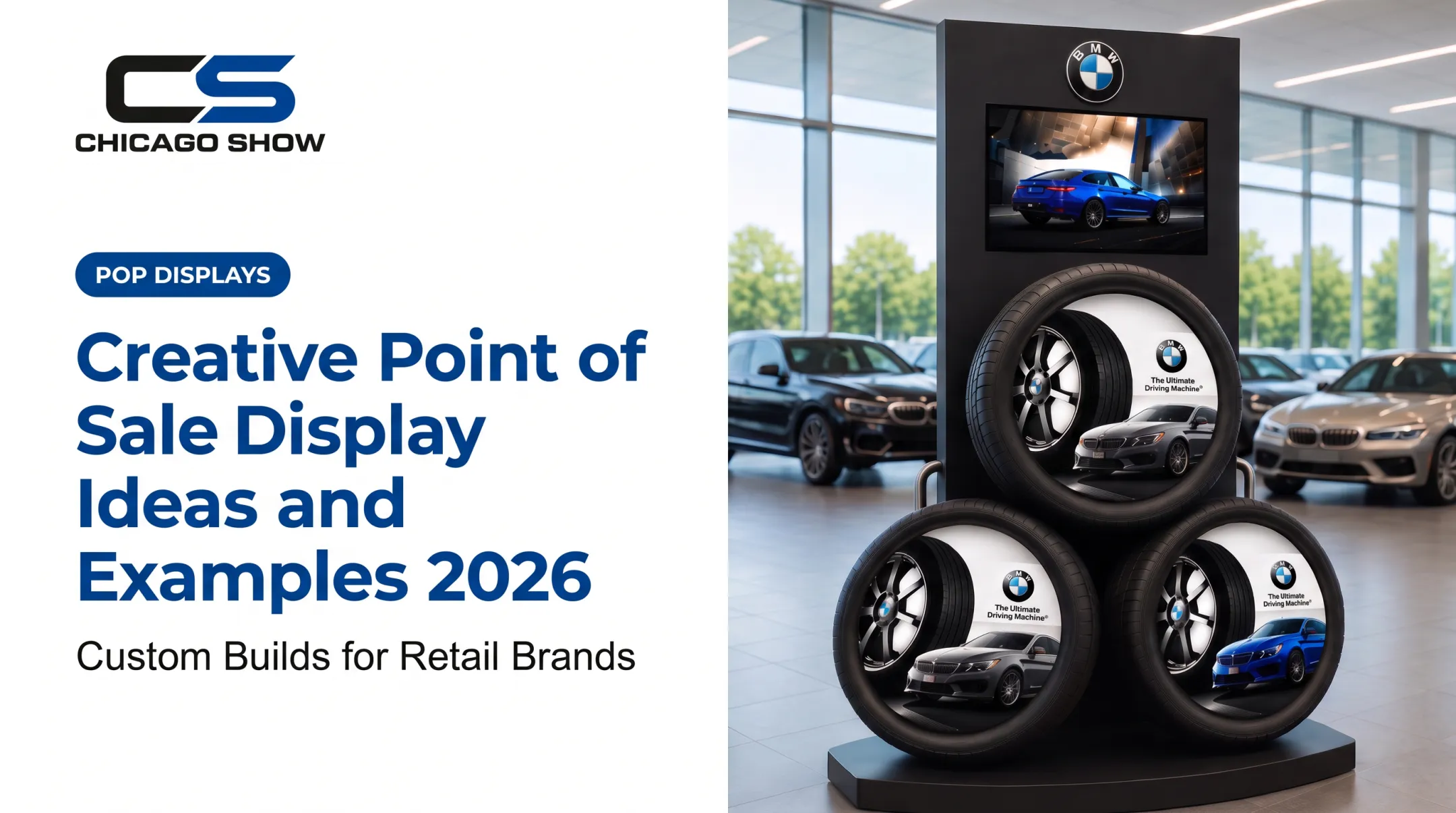
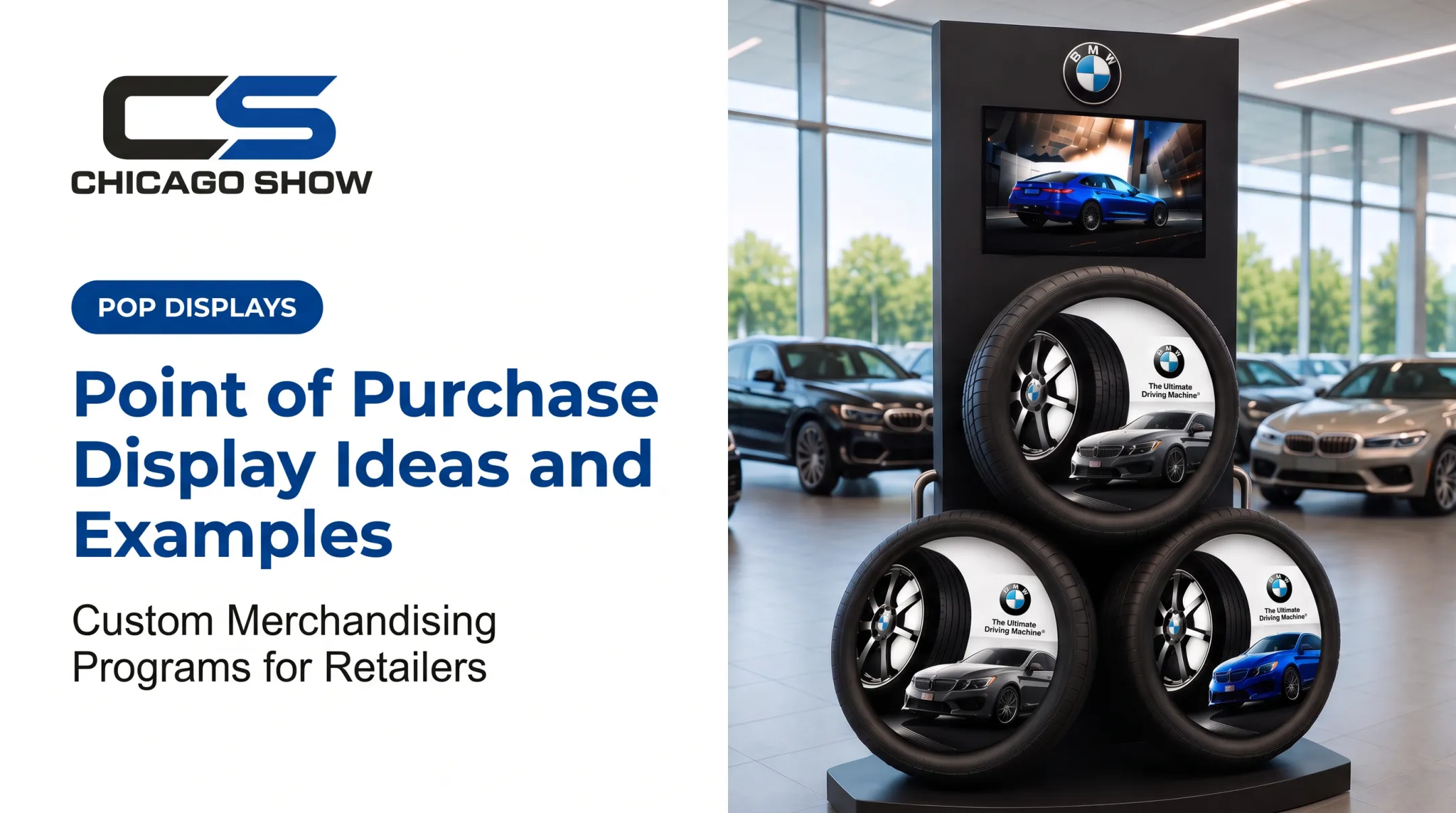
Chicago Show's BMW tire display pairs three physical tires and vehicle imagery with a top-mounted screen, so digital and physical elements reinforce the same message rather than competing for attention.
Trend 5: Sustainable, Accessible, and Field-Ready Display Design
A display that photographs well but fails inspection, blocks a walkway, or can't be reached by every customer isn't doing its job.
The 2010 ADA standards require a clear walking-surface width of generally 36 inches and an unobstructed forward reach of 15 to 48 inches for operable elements, per ADA.gov's design standards. Fixture placement and control height need to respect those limits from the planning stage, not after installation.
On materials, the FTC's Green Guides require a reasonable evidentiary basis for any environmental claim — so "eco-friendly" labeling needs real substantiation, not just a recycled-looking finish.
Practical specs to check:
- Reachable product samples and readable, high-contrast signage
- Durable, repairable components instead of disposable builds
- Materials matched to the operating environment (service drive, sales floor, outdoor)
Chicago Show's Materials and Specification process matches display materials to the operating environment before production starts, and Quality Oversight checks units against spec before they ship — catching problems before a display ever reaches the floor.
What's Driving These Showroom Display Trends
Several business forces are pushing showrooms in this direction simultaneously:
- Digital-signage growth (US market from $5.66B in 2024 to $7.15B by 2029, 4.8% CAGR per MarketsandMarkets) makes content updates cheaper without rebuilding fixtures
- Buyers increasingly want to test and compare before committing, especially on complex or higher-value purchases
- Multi-location brands want standardized components and shorter setup times, not custom one-offs per store
- Procurement teams increasingly specify durable, repairable, and accessibility-compliant materials upfront
- Brands need a distinctive showroom experience that still presents products consistently across dealer and distributor locations
Chicago Show's Recurring Program Support (reorders, refreshes, and rollout waves with retained program history) reflects this push toward repeatable, standardized programs rather than one-off builds.
How These Trends Are Impacting Showrooms
Operational Impact
Modular fixtures and documented specifications change daily workflows. Standardized components mean installation crews follow the same steps at every location, and digital content updates don't require a truck roll. Chicago Show's five-step process reflects this standardization: understand the program, review specs, manage production, manage delivery, and support after launch. Materials and engineering are finalized in-house before anything is built.

Business Impact
Measurement should match the goal. In-store retail media standards treat ad plays, "opportunities to see," and dwell time as separate metrics. They help track engagement, but none of them proves a sale happened (IAB Europe's 2024 standards). For consultative showrooms, practical indicators include:
- Qualified appointments or completed consultations
- Inquiry quality from sales staff feedback
- Cost per refresh versus full fixture replacement
Workforce Impact
Interactive and digital displays require trained staff. Teams need to demonstrate products confidently, troubleshoot basic tech issues, and feed customer questions back into display improvements. A fixture is only as effective as the person standing next to it.
Future Signals for Showroom Displays in 2026 and Beyond
Showroom design will keep evolving. Watch for these signals over the next one to three years:
- Configurable displays that update content without full fixture replacement
- Localized content for regional product mixes or language needs
- Remote-assisted selling connecting in-store shoppers with offsite specialists
- Sensor-based engagement measurement, still largely in pilot stages at major retailers
- Lower-impact materials, building on project-level cases like POPAI's retrofit example
Spatial computing visualization tools and AI-assisted recommendations are still limited pilots at individual retailers, not proven, scalable programs. Treat early demos as signals worth monitoring, not blueprints to copy right away.
Planning should scale to the situation:
- Small showroom: Prioritize one strong interactive focal point over multiple competing displays.
- High-volume dealer network: Build around standardized components, clear specs, and realistic install timelines.
- Rotating product portfolio: Invest in modular bays that accept new graphics and components without a full rebuild.
Chicago Show works with brands across these scenarios, from single showroom units to multi-location auto dealer programs for clients like Kia, Nissan, and Ford. The team manages concept through production, delivery, and recurring refreshes.
That doesn't guarantee a specific outcome for every program. It does mean specifications, timelines, and quality checks stay with one accountable partner rather than passing between vendors.
Conclusion
The strongest 2026 showroom display ideas combine visual appeal with product education, hands-on interaction, and operational practicality. A display that looks sharp but doesn't help a shopper compare options, or that can't survive a busy service drive, isn't actually doing its job.
Choose display concepts against the factors that shape real-world performance:
- Product and audience fit
- Floor space and traffic flow
- Budget and build quality
- Accessibility needs
- Durability in daily use
- Ability to refresh the program over time
A display built to last one campaign costs more in the long run than one designed to be updated.
Frequently Asked Questions
How do I make a showroom attractive?
Focus on one clear focal point, cohesive branding, and strong lighting. Keep layouts uncluttered, add a hands-on interaction point, and use signage that guides customers through a logical path.
What are the latest trends in showroom design?
Interactive demonstrations, modular fixtures, immersive storytelling, digital-physical hybrids, and sustainable, accessible materials are leading 2026 showroom trends. Measurable engagement is increasingly built into planning rather than added afterward.
What is the 3-5-7 rule in interior design?
The 3-5-7 rule is a styling guideline for grouping objects in odd numbers (three, five, or seven) with varied height and scale for visual balance. In a showroom, adapt it to your product, sightlines, and safety requirements rather than following it rigidly.