
An effective display guides the shopper. It gives a reason to pause, makes comparison easy, and survives daily store traffic. Decoration alone does none of that.
This guide is for wine brands, supermarket buyers, merchandising teams, and retail marketers. It covers display ideas, shopper psychology, design, placement, and rollout.
Key Takeaways
- Give shoppers one clear reason to stop, browse, and choose.
- Organize bottles by mission, occasion, style, or value, not decoration.
- Balance branding with stability, accessibility, and easy restocking.
- Test the full program in real stores before scaling.
Why Displays Influence Wine Shoppers
Grocery is where much of America buys wine. It accounts for 42% of measured wine dollar sales, according to NIQ data reported by NACS for the 52 weeks ending December 2024. That figure shows the channel's weight, not display lift, so treat it as context.
A dedicated display does two jobs.
- Visual interruption: it pulls the eye away from the standard shelf set.
- Simpler choices: it organizes bottles around a reason to buy, such as weeknight dinner, gifting, a celebration, price tier, flavor profile, or region.
Publix shows how this works at shelf level. Its shelf tags use icons that link wine style to foods, such as medium-bodied reds with pizza or grilled meats. Shoppers with no wine background can pick without guessing.
Connect Familiarity With Discovery
The best displays pair a recognizable bottle with something new. A known label reassures. A premium, regional, or limited-release option gives a reason to explore.
NIQ's 2024 beverage review found wines priced $15 to $20, and up to $25, defying broader category trends. That suggests many shoppers will trade up when the choice feels safe.

Clear signposting does the rest:
- Label each tier by price or style.
- Keep descriptions short, accurate, and approved.
- Skip claims about taste superiority or sales performance.
Supermarket Wine Display Ideas
Build a Branded Endcap or Freestanding Feature
An endcap sits at the aisle terminus, which Chicago Show calls the most contested floor space in the store. A branded unit breaks the aisle pattern and shows a focused range instead of an overwhelming one.
Practical guidance:
- Face labels forward so the bottle is the hero.
- Use side panels and headers for branding and the main message.
- Check viewing angles from both aisle approaches.
- Size the unit for store traffic. Bigger is not better if it blocks carts.
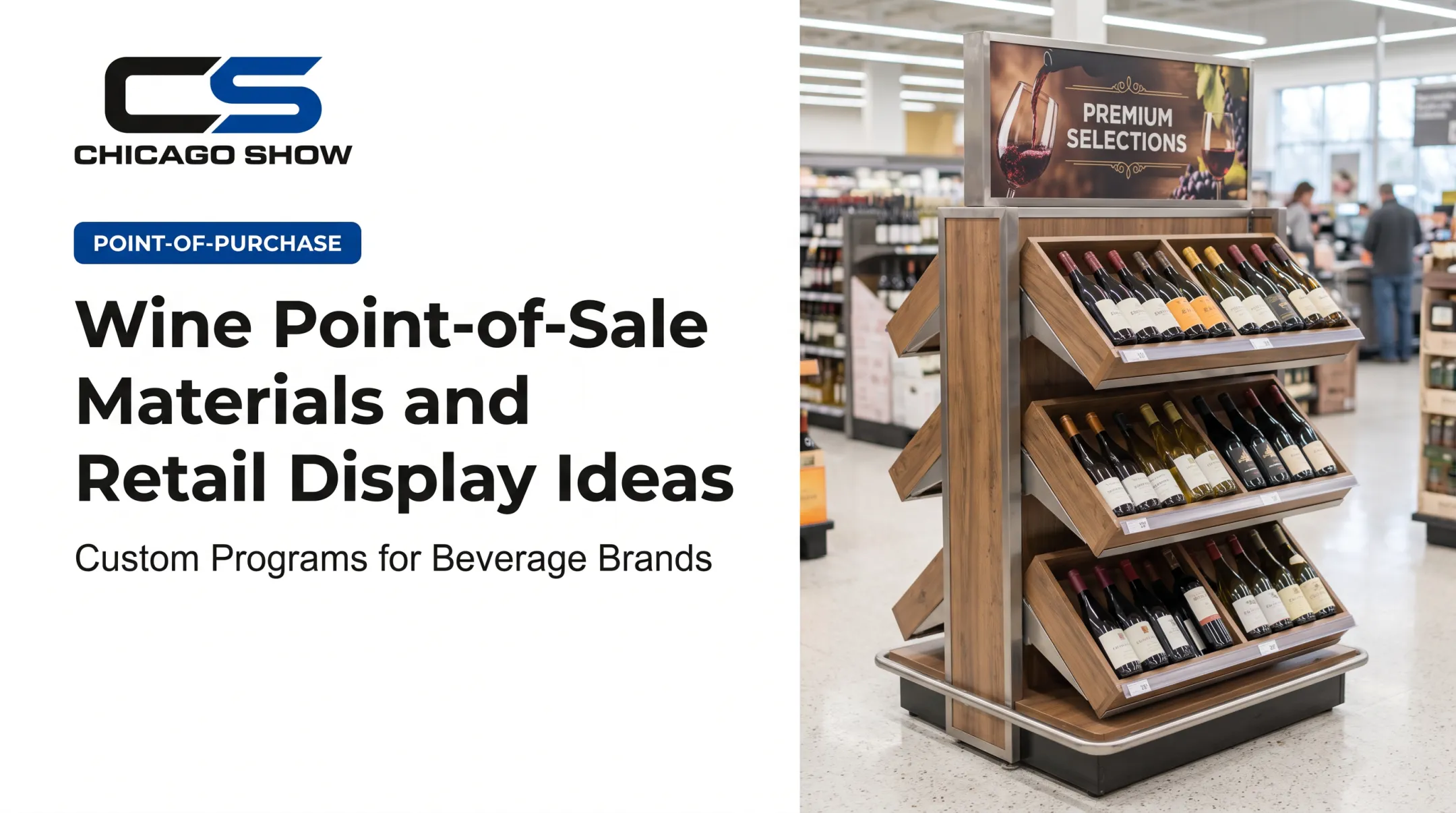
A double-sided freestanding gondola with branded graphic panels works when shoppers approach from several directions.
Create Seasonal and Occasion-Based Displays
Build around missions: holiday entertaining, dinner parties, grilling, gifting, and weeknight meals. Use a short line that says when to buy, such as "Game-day red" or "Host gift under $20."
Seasonal graphics and coordinated colors create a timely moment. Keep accessories minimal, and don't imply a food pairing you haven't verified. Mind the calendar too: according to NIQ's U.S. BevAl 2025 Year in Review, extra pre-New Year's shopping days shifted 2025 year-over-year comparisons, especially for wine and spirits gifting.
Use Food-Pairing and "Choose by Style" Navigation
Organize by meal occasion, sweetness, body, or varietal. Simple headers, icons, and shelf talkers let shoppers compare in seconds. Leave the bottle label visible.
Accuracy matters here. TTB treats shelf talkers as advertising, so wording must match the approved label and avoid misleading claims.
Make Premium or Limited-Release Bottles the Focal Point
Premium signals come from space, elevation, refined finishes, bottle glorifiers, and restrained copy. Give each bottle room.
Keep access practical. Price stays visible, shoppers can reach the bottle safely, and staff can restock fast. A display nobody can touch is a prop.
Highlight Alternative Formats and Value Options
Boxed wine, cans, multipacks, and large formats need different structures. Shanken documents U.S. 5L and 3L boxed brands such as Bota Box and Black Box, and Whole Foods lists canned wine in its assortment.
Plan around:
- Package weight and dimensions
- Shelf depth and load needs
- How shoppers lift and handle each pack
- Grouping by use occasion, not just format
Add Education, Storytelling, or Digital Support
Keep stories short: a producer line, a regional map, a harvest note, or a serving tip. A QR code can carry more depth.
Make any digital element support the physical display. It should load fast, work on a phone, and still make sense if the shopper looks for three seconds.
Design Principles That Turn Attention Into Action
Make Bottles Easy to See and Compare
- Face labels forward so shoppers can compare brands at a glance.
- Use tiered or angled shelves. A slanted wire rack, for example, tilts the shelf face toward the shopper.
- Keep bottle spacing consistent.
- Place prices where they can be read without bending or reaching.
- Check sightlines from the aisle entrance.
Once bottles are easy to see, set a clear hierarchy that moves the eye from main message to brand, range, price, then next action.

Keep the Message Short and Legible
Use one dominant message and brief support. Skip long tasting notes and competing calls to action.
shopPOPdisplays advises placing the main message at eye level and notes some shoppers need larger print. Use high contrast and test legibility from several feet away while walking.
Match Materials and Finishes to the Brand
| Material | Typical fit |
|---|---|
| Corrugated | Temporary or seasonal campaigns |
| Wood | Sturdy, versatile, warm premium look |
| Metal | Permanent, durable displays |
| Acrylic | Lightweight, modern look |
Mixed construction works too, such as a wood base with metal shelves. Choose for positioning first, then check cleaning, handling, transport, and storage. Budget and campaign length usually settle the rest.
Design for Stability, Safety, and Accessibility
Bottles are heavy. Address shelf loading, center of gravity, base stability, anti-tip features, sharp edges, and breakage risk.
Keep pathways clear. ADA guidance generally calls for a 36-inch minimum clear width on accessible routes. Retailers and fire codes also restrict aisle obstruction.
Alcohol rules vary by state. Colorado, for instance, limits temporary displays by store size, and federal tied-house rules cap supplier-furnished displays. Confirm requirements with the retailer and counsel. This is not legal advice.
Make Restocking Part of the Design
Store teams need:
- Fast inventory access
- Visible stock levels
- Simple assembly
- A unit that stays tidy after repeated handling
Test with realistic bottle counts and replenishment scenarios before approving production. Prototyping catches fit, assembly, and access problems early.
Plan the Display for Retail Execution
Choose Placement Based on the Shopper Mission
- Wine aisle: shoppers already shopping wine; compare and decide.
- Endcap: interrupts traffic; promotes a focused range.
- Entrance feature: seasonal or gifting impulse.
- Cross-merchandising: pair near meal-related zones.
- Checkout-adjacent: small, convenient formats where permitted.
Orient the strongest graphic side toward the main approach. For multi-direction access, use double-sided graphics and open product access. Placement permissions rest with the retailer.
Create a Repeatable Store-Level Program
Stores differ in footprint and assortment, so build with modular dimensions, swappable headers, adaptable graphics, and flexible product configurations.
Document the planogram, assembly steps, replenishment process, approved visuals, and store-specific variations so every location can execute the same way.
Build Around Transport and Fulfillment
Plan pack-out, protective packaging, shipping efficiency, assembly time, and storage between campaigns so units arrive intact and ready to set. Decide how complete kits reach each location and whether that path fits your rollout schedule.
Test, Measure, and Refresh the Display
Set a baseline first, then track:
- Display compliance and stock availability
- Shopper engagement
- Product movement and basket attachment
- Results by store format
NIQ In-Store Vision covers execution auditing. NIQ Matched Market Testing handles controlled store-level sales comparison. Use the first to confirm the display is in place and the second to estimate sales effect.
No public benchmark gives a reliable wine-display lift, so track results in your own stores.

Consider an End-to-End Display Partner
Chicago Show, founded in 1902, supports custom display programs from concept and engineering through production management, kitting, fulfillment, quality checks, delivery, and ongoing reorders or refreshes. For multi-location supermarket programs, a single accountable partner can reduce handoffs between design, production, and shipping.
Conclusion: Make the Display Earn the Shopper's Stop
The strongest supermarket wine displays combine visibility, simple communication, useful organization, and dependable daily operation. Before choosing a format, evaluate the shopper mission, store environment, product mix, and rollout needs. Then prototype, test, and scale.
Frequently Asked Questions
What are some cool ideas for wine storage?
In stores, try tiered shelving, safe rack concepts, boxed-wine bins, and seasonal features. Remember that shopper-facing merchandising differs from long-term home storage, which prioritizes stable conditions over presentation.
What makes a good wine display in a supermarket?
Clear bottle visibility, short messaging, stable construction, easy access, relevant placement, and simple replenishment. Each one supports the others.
How do you display wine to attract customers?
Interrupt the aisle visually, build around an occasion, face labels forward, and add pairing guidance. Close with a single clear call to action.
Where should a wine display be placed in a supermarket?
Match location to mission: aisle for comparison, endcaps for focus, high-traffic zones for gifting, cross-merchandising for meals. Confirm retailer permissions and state rules.
What materials work best for supermarket wine displays?
Corrugated suits short campaigns, wood and metal suit durable programs, and acrylic suits lightweight modern looks. Weigh brand positioning, bottle weight, budget, and transport.
How can brands keep a supermarket wine display stocked and organized?
Plan realistic capacity, give clear assembly instructions, ship with protective packaging, and design for fast replenishment. Schedule regular inventory checks and maintenance.