
Introduction
A wine aisle can hold hundreds of labels, and most look alike from four feet away. Point-of-sale materials give one bottle a reason to be noticed, understood, and picked up.
In its NIQ omnichannel report, NIQ found that 15% of US beverage-alcohol shoppers entered the store with no particular brand in mind. That figure covers beverage alcohol, not wine alone, but it shows how much choice happens at the shelf.
This guide is for wine brands, retailers, distributors, marketers, and agencies. It covers physical displays and printed materials, not checkout software. You'll find format ideas, selection criteria, design principles, production planning, and measurement.
Key Takeaways
- Match each format to one goal: awareness, education, seasonal promotion, or impulse sales.
- Choose materials by display lifespan, bottle weight, handling, and retailer rules.
- Keep product, message, and call to action readable at a glance.
- Plan proofing, approvals, fulfillment, and refreshes, not just the creative.
What Are Wine Point-of-Sale Materials?
Wine point-of-sale (POS) materials are physical assets placed near the product or along the purchase path. They attract attention, share information, promote an offer, or support a buying decision.
Federal rules define them similarly: items used inside a retail establishment to draw consumer attention to a product, such as posters, placards, and signs, per 27 CFR 6.84.
POS, POP, and Terminology
Point-of-sale, point-of-purchase, POP, and POS are used loosely and often interchangeably for in-store merchandising. Here, they mean physical materials, not transaction systems.
Purpose Changes by Shopper Moment
- Introducing a new wine: bold visibility and a simple hook
- Explaining a wine: tasting notes, varietal, food pairings
- Highlighting credibility: an award or occasion
- Promoting value: a clear price message
- Encouraging add-ons: a pairing suggestion near cheese or glassware
Wine POS Materials and Retail Display Ideas to Try
Shelf-Level Materials
Shelf talkers, neckers, wobblers, shelf strips, price cards, case cards, and small tags sit closest to the decision. Each can carry one idea: a tasting note, a pairing, an award, the origin, or a price.
Restraint matters. A shelf crowded with competing cards reads as noise.
There's real wine evidence here. A Northern California experiment attached expert-score labels to the shelf under 112 wines for four weeks in April 2006, then compared sales against a control store (Hilger, Rafert and Villas-Boas). It's a useful testing model, though old and not a universal lift benchmark.

Countertop and Checkout Displays
Countertop units, small risers, and bottle holders suit impulse decisions. They work well for limited releases, giftable bottles, seasonal picks, and smaller formats.
- Keep the footprint small so retailers will say yes
- Feature one or two products, not ten
- Add a short card with the offer
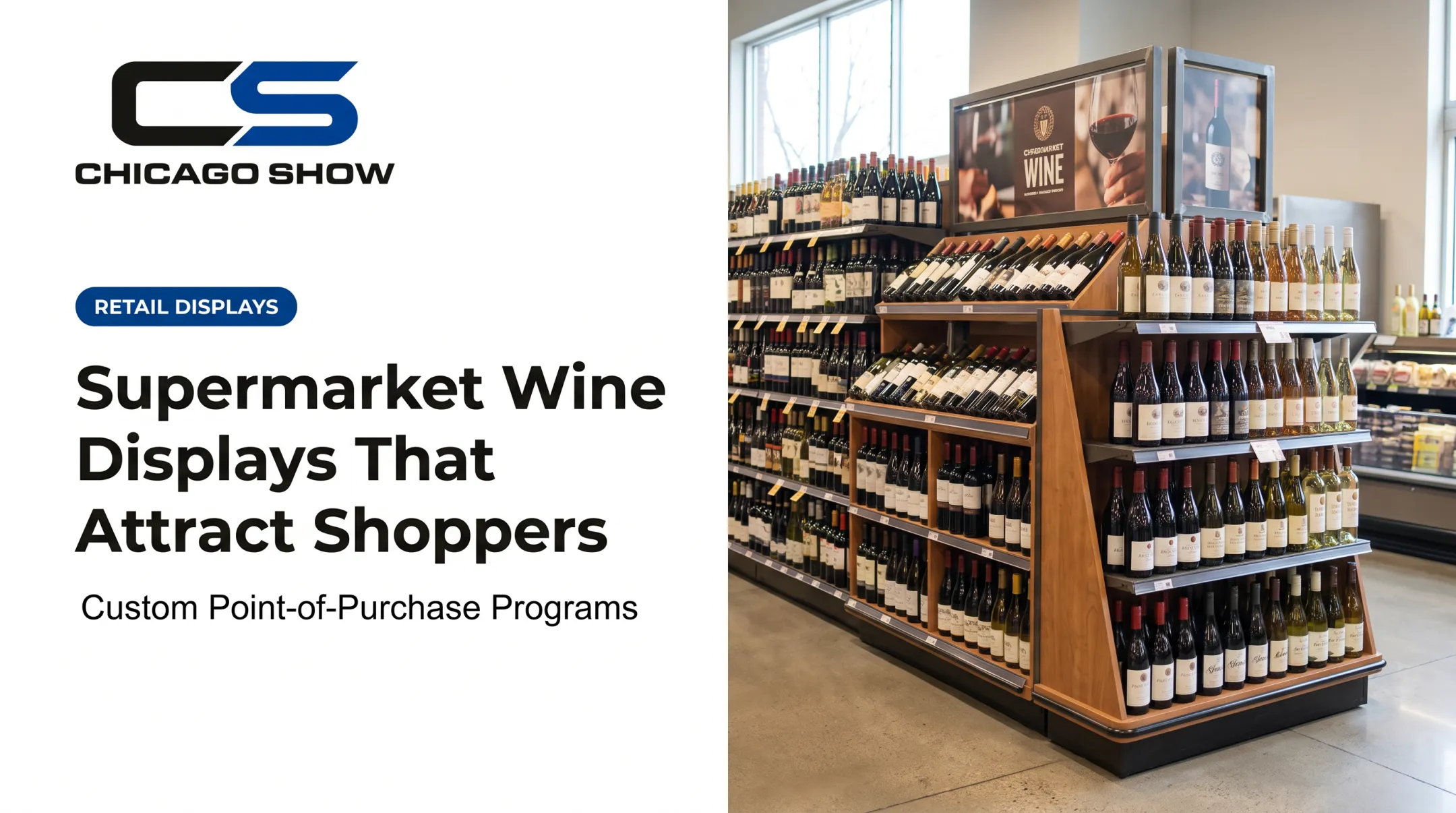
Floor Displays, End Caps, and Case Stacks
Freestanding units, end caps, case stacks, dump bins, and pallet presentations create volume and visibility. Evaluate each on:
- Height and bottle visibility
- Product capacity
- Footprint in the aisle
- How easily staff can replenish
End caps are the most contested floor space in a store, so campaigns for them need a clear featured message and durable construction if they return annually.
Branded Signage and Environmental Elements
Posters, banners, backer cards, floor graphics, aisle signs, and ceiling danglers carry launches, seasonal themes, and brand stories. They also direct shoppers to where the wine lives. Use them to pull people toward the product, then let shelf-level pieces close the sale.
Interactive, Seasonal, and Educational Concepts
- QR codes can link to tasting notes, recipes, pairings, or winery stories. Keep pages current and mobile-friendly, and test engagement since public US scan-rate data is hard to find.
- Seasonal themes include holiday gifting, summer patio wines, new releases, and regional spotlights.
- Educational displays can explain a grape or region, but avoid unsupported claims about health, quality, or sustainability.
How to Choose the Right Wine POS Material or Display
Match the Format to the Retail Objective
| Objective | Best-fit format |
|---|---|
| Quick education | Shelf talkers, neckers |
| Visibility and volume | Floor displays, case stacks |
| Compact promotion | Countertop units |
| Featured campaign | End caps |
The desired shopper action should drive the message and call to action, not the other way around.
Match the Display to Location and Footprint
Before specifying a unit, check:
- Width, depth, and height available
- Sightlines and shopper traffic
- Aisle adjacency and checkout placement
- Retailer planograms
- Nearby complementary categories, such as cheese or gourmet food
Accessibility also matters. ADA guidance generally places unobstructed forward reach at 15 to 48 inches, and routes past floor displays should keep a 36-inch minimum clear width.
Select Materials by Campaign Duration and Handling
Corrugate suits short, high-volume campaigns. Wood, metal, and acrylic suit reusable or premium programs. Humidity is a real concern for cardboard: a 2018 FBA technical report notes humidity above 70% can soften adhesives and warp board, and below 30% can make it brittle.

Ask suppliers for current data on durability, finish, and recyclability. Never assume a material is recyclable or sustainable without documentation.
Design for Bottle Weight, Safety, and Replenishment
Bottles are heavy, and a full case is heavier. Ask for confirmed load ratings rather than judging by appearance. Check for:
- Stability and tipping risk, especially on tall freestanding units
- Scuff and spill resistance
- Easy reach for shoppers and staff
- Space for backstock and a simple restocking routine
A beautiful display that wobbles will be pulled from the floor.
Balance Initial Cost with Reuse and Rollout
A disposable unit costs less up front. A reusable base with replaceable graphics can cost less over several campaigns. Compare total program value, including:
- Production quantity and setup labor
- Shipping volume and storage
- Regional variations
- Pilot quantities before full rollout
- Refresh cycles
How to Design and Execute a Retail-Ready Wine Display
Build a Clear Visual Hierarchy
Order information the way a shopper reads it: brand or product, primary differentiator, supporting detail, call to action. Keep copy short, contrast strong, and text legible from the expected viewing distance.
Make the Bottle and Label Easy to See
Face the label forward, and mind lighting and display height. Lifestyle imagery can set a mood, but it should never compete with the bottle.
Review Retailer Requirements and Compliance
Alcohol marketing is regulated, so build in review time.
- Retailer approval: planogram limits, fixture specs, and pricing accuracy
- Federal wine advertising rules: 27 CFR Part 4 requires advertiser identification, a class or type statement matching the label, and no misleading claims
- Supplier-to-retailer rules: product displays carry a federal value limit of $300 per brand, per establishment, at any one time, while POS advertising materials fall under a separate provision
- State and local rules: these vary, so get legal review before supplying materials
- Environmental claims: FTC Green Guides apply to any recyclable or sustainable claim
Prototype and Test in a Realistic Environment
Review a physical prototype or accurate mockup. Check bottle fit, readability, stability, assembly time, sightlines, and replenishment. Get feedback from retail reps and field teams before a broad rollout.
Coordinate Production, Fulfillment, and Field Execution
Approved specifications, proofing, quality checks, assembly instructions, pack-out, shipping protection, and reorder processes all need an owner.
Chicago Show, a custom display-program partner founded in 1902, handles this chain through one accountable contact:
- Concept development and engineering coordination
- Production management, kitting, and fulfillment
- Quality checks against specification before shipping
- Ongoing refreshes and reorder support
Brands remain responsible for retailer brand-standards approval and alcohol-law compliance.
Measure and Improve Wine Display Performance
Define KPIs by the display's purpose:
- Placement compliance and display availability
- Product visibility
- QR engagement and trial participation
- Unit sales, sell-through, and basket impact
- Replenishment frequency, setup time, and damage
- Retailer and field-team feedback
No transferable US wine-display lift benchmark exists across formats, so avoid borrowing generic percentages.
Separate promotion types when reading results. NIQ distinguishes temporary price reductions, features, and displays, and a combined result doesn't prove the display worked.
Run a Controlled Pilot
Compare test stores with similar control stores where possible. Document location, featured products, promotion, timing, and inventory availability before interpreting results. An out-of-stock display tells you nothing about the creative.

Refresh Based on Findings
Use results and field feedback to:
- Update graphics and messaging
- Improve bottle access
- Reinforce weak construction
- Adjust quantities
- Keep modular components that performed
Program history helps here. Keeping specifications across campaign years lets a refresh reuse a proven footprint.
Frequently Asked Questions
What is point-of-sale material?
Physical marketing or merchandising material placed near a product or purchase area. It attracts attention, educates shoppers, promotes an offer, or supports a buying decision.
What are examples of wine point-of-sale materials?
Common examples include shelf talkers, neckers, case cards, posters, banners, countertop displays, end caps, floor stands, case stacks, and QR-enabled educational pieces.
What is the difference between POS and POP materials?
The terms are often interchangeable. Some retailers use POS for materials near checkout and POP for the broader purchase environment.
Which materials work best for wine retail displays?
It depends on campaign length, store handling, bottle weight, budget, and retailer requirements. Decide whether the display should be disposable, reusable, premium, or modular.
How can a wine brand make its retail display stand out?
Show the bottle clearly, keep the message short, stay consistent with brand look, and choose the right placement. Seasonal relevance, practical construction, and one focused call to action help too.
How should wine POS displays be measured and refreshed?
Set KPIs tied to the display's goal, pilot first, and gather retailer and field feedback. Check availability, review sales or engagement data, and schedule updates to graphics, products, or construction.